


Best platform tennis paddles in 2026
Best overall: a repeatable-control fit. Best for quick exchanges: a fast-handling fit. Best budget choice: keep your current paddle if it still performs reliably. The best platform tennis paddles in 2026 are the ones that help you repeat your shots under pressure; miPADDLE helps you work on the technique behind those shots.
- The best platform tennis paddles give you repeatable control before extra pace or spin.
- Choose a fast-handling fit when preparation breaks down during quick volley exchanges.
- Keep your current paddle when it performs reliably; change it to solve a specific problem.
- miPADDLE is best for platform tennis players who want short, on-demand lessons between club sessions.
Why this matters
A paddle purchase should solve a problem you can name. Late contact, inconsistent depth and uncomfortable handling deserve different decisions—not the same recommendation from a teammate.
Start with your matches. Do you lose control when blocking a hard ball, struggle to prepare at net, or rush a ball coming off the screen? Those observations give you a useful buying brief. A model name does not.
This 2026 guide ranks paddle fits by the job you need them to do. It does not assign performance characteristics to products based on their names. Use the rankings to choose what to test, then let your own hitting decide which model earns a place in your bag.
What makes the best platform tennis paddles?
Use these criteria before comparing models. A paddle that wins one drill but disrupts the rest of your game is not your best overall choice.
- Repeatable control: You can send routine shots toward your intended target without repeatedly changing your swing.
- Preparation: You can get the paddle ready during quick exchanges without rushing your contact.
- Contact stability: The paddle feels manageable when you block pace or contact the ball away from the center.
- Grip comfort: You can hold the paddle securely without squeezing throughout the rally.
- Shot coverage: The paddle works for volleys, overheads, serves and screen play—not just your favorite shot.
- Match transfer: The benefit survives live points, when you do not know where the next ball is going.
Pick the fit that improves your weak situation without taking away a dependable shot. That is a better buying rule than choosing the paddle that produces your hardest practice winner.
Best paddle fits at a glance
| Rank and paddle fit | Best for | Standout selection criterion | Key limitation |
|---|---|---|---|
| 1. Repeatable-control fit | Undecided club and league players | Predictable results across routine shots | A comfortable rally alone does not prove match performance |
| 2. Fast-handling fit | Players who rush quick volley exchanges | Preparation and recovery at net | Easy handling does not establish contact stability |
| 3. Stable-contact fit | Players who struggle when blocking pace | Manageable contact on defensive shots | A solid feel can still come with handling you dislike |
| 4. Spin-supporting fit | Players with an established spin technique | Repeatable trajectory with the normal swing | A spin-related model name does not establish results |
| 5. Familiar replacement fit | Players whose current setup already works | Continuity with a dependable paddle | Familiarity can keep you from investigating a real problem |
These are distinct buying priorities, not fixed equipment categories. The same paddle can suit different players for different reasons. Your job is to identify which benefit matters most and then check the trade-offs.
1. Repeatable-control fit: best platform tennis paddle for consistency
A repeatable-control fit lets you play ordinary balls without feeling that every shot needs a correction. Look for manageable volleys, dependable overhead placement and comfortable contact during screen play. Your default swing should stay recognizable.
This is the first choice for an undecided player because it addresses the whole match. Extra pace on one shot is less useful if you spend the next rally compensating for unpredictable depth.
If the Xenon Vector Pro is on your shortlist, put it through the same control test as your current paddle. Treat it as a candidate, not an automatic winner. The product name alone does not answer whether it fits your game.
Repeatable-control fit pros:
- Gives you a clear target for an all-court comparison.
- Keeps attention on shots you use throughout a match.
- Helps distinguish reliable improvement from an occasional standout shot.
Repeatable-control fit cons:
- Cooperative hitting can hide problems that appear under pressure.
- Familiarity can make your current paddle feel better during the first comparison.
Best for: Competitive adults who want a dependable starting point rather than a specialized equipment experiment.
Verdict: Buy only after the control benefit holds up in live points.
2. Fast-handling fit: best platform tennis paddle for quick exchanges
A fast-handling fit feels manageable when you prepare, block and recover at net. Test it during exchanges that force you to react rather than during comfortable feeds alone. You should be able to return to a ready position without rebuilding your grip.
Do not equate handling with a weight claim. The useful question is whether the paddle works in your hand while the point speeds up. A specification cannot replace that comparison.
Also check why you are late. If you begin preparing after the ball reaches you, changing equipment does not fix the sequence. Get ready earlier, then compare paddles with that improved preparation.
Fast-handling fit pros:
- Focuses your test on preparation and recovery.
- Makes quick volley exchanges part of the buying decision.
- Gives you a specific alternative to choosing solely for attacking pace.
Fast-handling fit cons:
- Easy movement does not prove dependable contact against a hard ball.
- Comfortable net play does not establish a good fit for overheads or screens.
Best for: Players whose main equipment concern is managing the paddle during fast exchanges.
Verdict: Buy if preparation improves without sacrificing defensive control.
3. Stable-contact fit: best platform tennis paddle for blocking pace
A stable-contact fit feels manageable when you absorb an incoming ball instead of taking a full swing. Compare it on defensive volleys and less comfortable contact, not just clean shots from the center. The result you want is a ball you can place, not merely a contact sensation you enjoy.
Keep the test honest. Use similar feeds and alternate with your current paddle so that a change in incoming pace does not become a supposed equipment advantage.
Notice your hand as well as the ball. If you keep tightening your grip to make the paddle feel secure, pause the comparison and review the grip setup. Do not accept discomfort as the cost of a solid feel.
Stable-contact fit pros:
- Prioritizes defensive shots that attacking drills can overlook.
- Tests control when contact is less comfortable.
- Encourages you to assess grip security alongside ball placement.
Stable-contact fit cons:
- A solid contact sensation does not guarantee better shot placement.
- The handling can still feel awkward during quick preparation.
Best for: Players who already prepare on time but dislike how their paddle behaves when blocking pace.
Verdict: Buy if defensive placement improves and the paddle remains manageable throughout the point.
4. Spin-supporting fit: best platform tennis paddle for an established swing
A spin-supporting fit belongs on your shortlist when you already produce the intended shot and want to compare how different paddles work with that technique. Keep your normal swing. Look at repeatable trajectory and placement rather than changing your motion to chase a dramatic result.
The Xenon Vector Pro Spin Max V2 is a named option to inspect. Its name is not a substitute for an on-court comparison, and it does not establish how much spin you will produce.
For your 2026 decision, test ordinary shots as carefully as the spin shot that attracted you. A paddle that encourages experimentation still needs to work when you block, defend and reset.
Spin-supporting fit pros:
- Gives an established technique a specific comparison test.
- Keeps trajectory and placement ahead of product wording.
- Encourages you to evaluate attacking and neutral shots together.
Spin-supporting fit cons:
- It cannot replace instruction on contact and swing path.
- One successful attacking shot says little about all-court fit.
Best for: Players who can already repeat a spin shot and want to evaluate equipment without changing their technique.
Verdict: Wait if the technique is inconsistent; buy only when the whole-game comparison supports the change.
5. Familiar replacement fit: best platform tennis paddle for continuity
A familiar replacement fit makes sense when your current paddle supports your game and the reason for replacing it is its condition, not its playing characteristics. Start by identifying what you want to preserve: comfortable handling, grip feel or predictable response.
Inspect the existing paddle before deciding. Look for visible damage or loose components, and separate a worn grip from a reason to replace the entire paddle. Stop using equipment that appears unsafe and have it assessed.
Do not assume another paddle with the same name will feel identical in your hand. Compare the actual replacement with the familiar setup whenever you can.
Familiar replacement fit pros:
- Preserves a setup you already understand.
- Makes your current paddle a useful reference.
- Avoids changing equipment simply because a new season has arrived.
Familiar replacement fit cons:
- Familiarity can hide an equipment issue you have learned to tolerate.
- A replacement still needs its own comfort and hitting check.
Best for: Players who like their current paddle and want continuity rather than a different playing experience.
Verdict: Hold if your current paddle remains dependable; replace it when condition or a demonstrated fit problem justifies the change.
How to test a platform tennis paddle before choosing
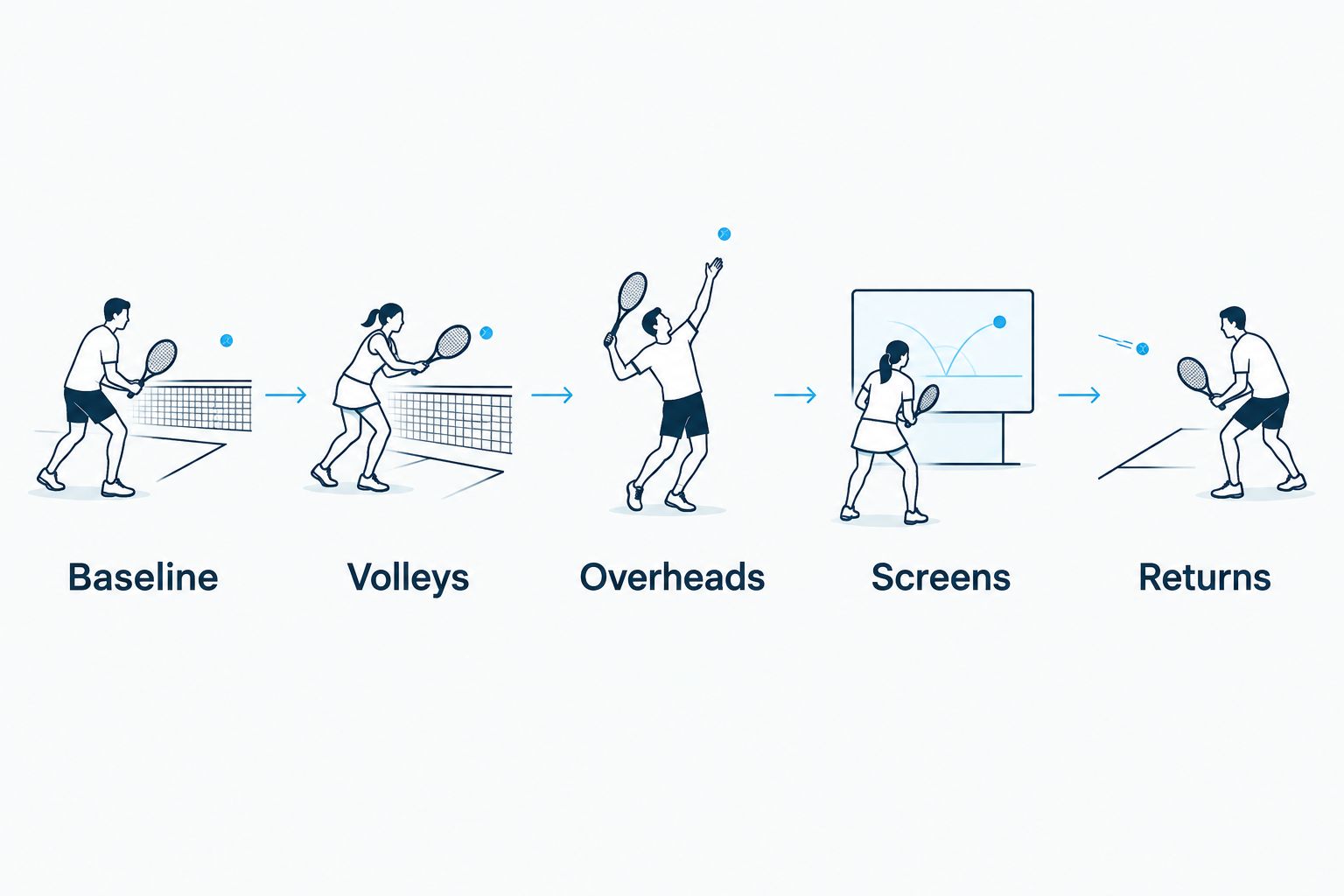
Give each candidate the same sequence. For a useful 2026 comparison, alternate with your current paddle and keep the partner, feeds and targets as consistent as practical.
Baseline
Describe the problem with your current paddle before hitting. Use an observable statement, such as losing placement on defensive volleys. Avoid a vague target like wanting something better.
Volleys
Compare controlled feeds first, then faster exchanges. Check whether you prepare comfortably, make manageable contact and recover for the next ball. Do not judge only the first volley.
Overheads
Use your ordinary overhead motion and a defined target. Notice whether you keep changing the swing to control depth. Include the overhead you use to maintain the point, not only the attacking version.
Screens
Play balls off the screen and assess preparation, spacing and contact. Keep the footwork task separate from the equipment question. A rushed setup is not proof that the paddle is wrong.
Returns
Finish with serve returns and live points. Check whether the earlier benefit survives an unpredictable ball and the need to choose a shot. Write down the trade-off before making your decision.
Fix the shot before blaming the paddle
Equipment and instruction answer different questions. A paddle comparison tells you which setup feels and performs better for you. Instruction helps you change preparation, contact and decisions.
miPADDLE platform tennis lessons are taught by the top players and instructors in the game. The membership includes 190+ lessons, covering screens, overheads, serves, volleys and strategy. Most lessons run 2–6 minutes, so you can focus on the situation you want to address before your next session.
The strength of miPADDLE platform tennis instruction is focused, on-demand learning; the limitation is that watching a lesson does not replace practicing the shot or getting live feedback. Use the lesson to identify an adjustment, then take that adjustment onto the court.
A club instructor is useful when you need someone to observe your actual movement and contact. Video instruction is useful when you want to revisit a specific explanation between sessions. Neither tells you which paddle fits your hand without a hitting comparison.
How the paddle fits are ranked
Repeatable control ranks first because it is the broadest starting point for an undecided player. Fast handling and stable contact follow because they address different match problems. Spin support is a narrower priority, while a familiar replacement serves players who already have a dependable fit.
The criteria are control, preparation, contact stability, grip comfort, shot coverage and match transfer. These rankings are a decision order, not a claim that one named model outperforms another. Move a specialized fit to the top when it matches your demonstrated problem.
Which platform tennis paddle should you choose?
For most undecided readers, start with a repeatable-control comparison against the paddle you own. Keep the current setup if the challenger does not deliver a clear benefit in live points.
For your 2026 purchase, finish this sentence before buying: the new paddle helps me handle this specific situation without weakening this dependable shot. If you cannot fill in both parts, keep testing. A clear trade-off is more useful than enthusiasm after a comfortable hitting session.
FAQ
What's the best platform tennis paddle for a club player?
The best platform tennis paddle for a club player is the one that provides repeatable control across the shots used in matches. Start with an all-court comparison against your current paddle, then prioritize a specialized fit only for a specific problem.
Should I choose a paddle for control or power?
Choose repeatable control first when you are undecided. Test attacking shots too, but do not trade away dependable volleys, overhead placement or defensive shots for an occasional harder ball.
Does a spin-related paddle name mean I will get more spin?
A spin-related paddle name does not establish how much spin you will produce. Compare trajectory and placement with your normal technique, and check that the paddle still works for neutral and defensive shots.
Is the Xenon Vector Pro better than the Xenon Vector Pro Spin Max V2?
Neither is automatically the better fit for every player. Compare the actual paddles using the same feeds, targets and live-point situations rather than assigning performance differences from their names.
When should I replace my platform tennis paddle?
Replace your paddle when its condition requires attention or an on-court comparison establishes a better fit. Inspect visible damage and loose components, and distinguish a grip issue from a reason to replace the whole paddle.
Can platform tennis video lessons help before I buy a paddle?
Platform tennis video lessons can help you identify a technique adjustment before changing equipment. miPADDLE offers 190+ lessons taught by the top players and instructors in the game; practice the adjustment before judging the paddle.
What should I test when choosing a platform tennis paddle in 2026?
Test volleys, overheads, screen play, serve returns and live points when choosing a platform tennis paddle in 2026. Use your current paddle as the baseline and give every candidate the same sequence.
One last thing
The useful final test is not your best shot. It is the next ball after that shot. Can you recover, prepare and play it without fighting the paddle? Make that part of the decision.
For your 2026 improvement plan, pair the equipment test with a focused practice goal. Choose the miPADDLE annual membership with its $100 shop credit when you want ongoing platform tennis instruction between club sessions. The annual membership includes a 7-day free trial; start with the lesson that addresses the point you keep losing, then practice the fix.